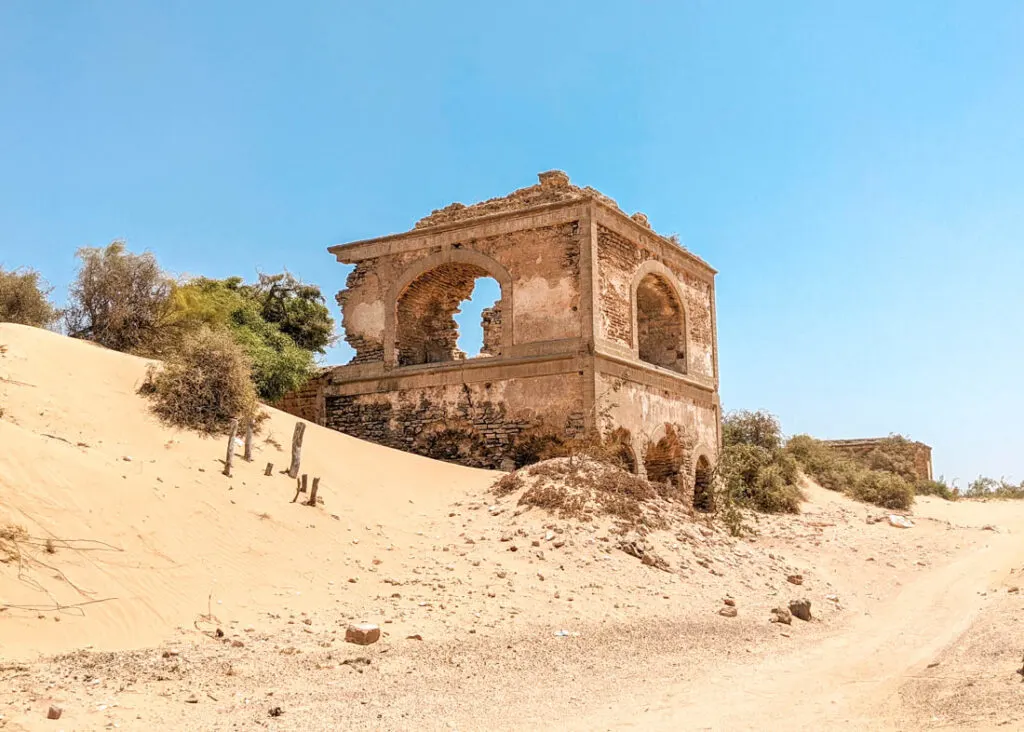
The Sultan’s Ruined Palace of Diabat: History, Legend, and Hope for Restoration
Introduction
Hidden between the rolling dunes and the Atlantic shore, just beyond the village of Diabat, lie the haunting ruins of the Sultan’s Palace, often called Dar Sultan or Dar Soltane. Once a splendid residence of royalty, today it stands half-buried in sand, a testament to Morocco’s layered history, to nature’s power, and to human memory. At Essaouira HorseRiding, we believe places like this deserve to be known, preserved, and felt, not just admired from a distance, but appreciated in their full story.
Historical Background
- Origins & Function
The palace was built in the 18th century by a wealthy court member named Hoban, who later offered it to Sultan Sidi Mohammed ben Abdallah. It served as a summer residence and place of retreat for dignitaries. - Later Use and Ownership
In the 19th century, the palace came under the care of Moulay Abderrahmane, Khalifa (ruler) of Mogador (the historical name for Essaouira). During his reign (1822-1858), it hosted high dignitaries of the court. - Architectural Features
For its time, Dar Sultan was considered quite “modern.” It had European-style furnishings, and even glass windows imported and installed by Dutch craftsmen. It had pavilions, a central patio, and gardens overlooking the dry wadi (valley) basins nearby.
Decay, Legend, and Present State
- Over many decades, the palace has suffered from desert sands, relentless ocean winds, neglect, and vandalism. Much of its structure has collapsed, and many rooms are ruined, though traces of mosaics, arches, and the outlines of patios are still visible.
- A curious legend involves the rockstar Jimi Hendrix. It is often claimed that he was inspired by Dar Sultan’s ruins when writing “Castles Made of Sand”. However, historians point out the song was released two years before his visit to Morocco; so while the legend is romantic, it doesn’t hold up chronologically.
Access, Restoration, and the Role of Essaouira HorseRiding
- Access Changes
Currently, it is not possible to ride horses directly into the palace ruins (or very close) due to their fragile state. For safety and conservation reasons, restrictions have been put in place. Plans are reportedly underway to restore the site under the oversight of heritage authorities. - Plans for Renovation
Although detailed public plans are not fully confirmed, the palace was officially registered as part of Moroccan National Heritage in 2020 by the National Institute of Archaeology and Heritage (INSAP). This status often brings with it plans for preservation and restoration. - Essaouira HorseRiding’s Connection
At Essaouira HorseRiding, we deeply respect the cultural legacy the palace represents. While we currently cannot include the palace within our horse-riding routes (for everyone’s safety and to avoid damage), we include it as a highlight along some of our walks (on foot) or rides that pass at a respectful distance. Our guides share its history and stories, helping visitors connect with this remarkable ruin. We look forward to the day restoration might allow safe, more immersive access again.
Curious Facts
- Guidepost for Mariners: Because Dar Sultan is perched near the coastline and somewhat prominent in its original form, it served as a visual landmark for sailors navigating the Bay of Essaouira.
- Vanishing in Sand: It is partially swallowed by dunes; in many seasons, wind-blown sand covers large parts of its lower walls, mingling ruin with terrain in such a way that the palace seems like part of the landscape itself.
- No Entry Fee: The ruins are open for visitors to walk around (at a distance) at no cost. There is no formal gate or entrance fee, though access may be subject to safety.
Why It Matters
Preserving Dar Sultan is not only about conserving stones and façades. It’s about keeping alive a chapter of Moroccan history: the era when Essaouira (Mogador) was an important port city, cultural crossroads, and a place where local tradition and international trade blended. For travelers, it offers more than beauty: it offers perspective, whispering stories of power, loss, and nature’s reclamation.
Visiting Tips (Even If Not on Horseback)
- Bring good walking shoes: the terrain is uneven and sandy.
- Visit around sunrise or late afternoon: softer light makes the ruins look magical; also cooler weather.
- Pack water and sun protection, there’s little shade.
- Stay at a safe distance from unstable walls or roofless sections.
- Combine with a trip to Borj El Berod (a ruined tower nearby) for a fuller historical day.
Conclusion
Dar Sultan Palace in Diabat remains both ruin and romance: a silent storyteller of Morocco’s coastal heritage. At Essaouira HorseRiding, we honor its past, respect its present fragility, and eagerly anticipate its restoration. Whether you visit on foot, view it from afar, or listen to its stories through our guided rides and tours, its presence enriches every journey.